 Teaching
Special Functions – Orthogonal polynomials – Hermite polynomials
The Hermite polynomials are orthogonal on the interval \((-\infty,\infty)=\mathbb{R}\) with respect to the normal distribution \(w(x)=e^{-x^2}\). They can be defined by means of their Rodrigues formula:
\[H_n(x)=\frac{(-1)^n}{w(x)}D^nw(x)=(-1)^ne^{x^2}D^ne^{-x^2},\quad n=0,1,2,\ldots.\tag1\]Since \(D^{n+1}=D\,D^n\), we obtain
\begin{align*} D^{n+1}w(x)&=D\left[D^nw(x)\right]=(-1)^nD\left[w(x)H_n(x)\right]=(-1)^n\left[w'(x)H_n(x)+w(x)H_n'(x)\right]\\[2.5mm] &=(-1)^{n+1}w(x)\left[2xH_n(x)-H_n'(x)\right],\quad n=0,1,2,\ldots, \end{align*}which implies that
\[H_{n+1}(x)=2xH_n(x)-H_n'(x),\quad n=0,1,2,\ldots.\tag2\]The definition (1) implies that \(H_0(x)=1\). Then (2) implies by induction that \(H_n(x)\) is a polynomial of degree \(n\). Further we have that \(H_{2n}(x)\) is even and \(H_{2n+1}(x)\) is odd and that the leading coefficient of the polynomial \(H_n(x)\) equals \(k_n=2^n\).
The Hermite polynomials satisfy the orthogonality relation
\[\frac{1}{\sqrt{\pi}}\int_{-\infty}^{\infty}e^{-x^2}H_m(x)H_n(x)\,dx=2^n\,n!\,\delta_{mn},\quad m,n\in\{0,1,2,\ldots\}.\tag3\]To prove this we use the definition (1) to obtain
\[\int_{-\infty}^{\infty}e^{-x^2}H_m(x)H_n(x)\,dx=(-1)^n\int_{-\infty}^{\infty}H_m(x)D^ne^{-x^2}\,dx.\]Now we use integration by parts \(n\) times to conclude that the integral vanishes for \(m < n\).
For \(m=n\) we have using integration by parts
\[\int_{-\infty}^{\infty}e^{-x^2}H_n(x)H_n(x)\,dx=(-1)^n\int_{-\infty}^{\infty}H_n(x)D^ne^{-x^2}\,dx =\int_{-\infty}^{\infty}D^nH_n(x)\cdot e^{-x^2}\,dx=k_n\,n!\,\int_{-\infty}^{\infty}e^{-x^2}\,dx=2^n\,n!\,\sqrt{\pi}.\]This proves the orthogonality relation (3).
In order to find the three-term recurrence relation we start with
\[w(x)=e^{-x^2}\quad\Longrightarrow\quad w'(x)=-2xw(x).\]Then we have by using Leibniz' rule
\[D^{n+1}w(x)=D^nw'(x)=D^n\left[-2xw(x)\right]=-2xD^nw(x)-2nD^{n-1}w(x),\]which implies that
\[H_{n+1}(x)=2xH_n(x)-2nH_{n-1}(x),\quad n=1,2,3,\ldots.\tag4\]Combining (2) and (4) we find that
\[H_n'(x)=2nH_{n-1}(x),\quad n=1,2,3,\ldots.\tag5\]Differentiation of (2) gives
\[H_{n+1}'(x)=2xH_n'(x)+2H_n(x)-H_n''(x),\quad n=0,1,2,\ldots.\]Now we use (5) to conclude that
\[2(n+1)H_n(x)=2xH_n'(x)+2H_n(x)-H_n''(x),\quad n=0,1,2,\ldots,\]which implies that \(H_n(x)\) satisfies the second-order linear differential equation
\[y''(x)-2xy'(x)+2ny(x)=0,\quad n\in\{0,1,2,\ldots\}.\]Finally we will prove the generating function
\[e^{2xt-t^2}=\sum_{n=0}^{\infty}\frac{H_n(x)}{n!}\,t^n.\tag6\]We start with
\[f(t)=e^{-(x-t)^2}=e^{-x^2}\cdot e^{2xt-t^2}.\]The Taylor series for \(f(t)\) is
\[f(t)=\sum_{n=0}^{\infty}\frac{f^{(n)}(0)}{n!}\,t^n\]with, by using the substitution \(x-t=u\),
\[f^{(n)}(0)=\left[\frac{d^n}{dt^n}\,e^{-(x-t)^2}\right]_{t=0} =(-1)^n\left[\frac{d^n}{du^n}\,e^{-u^2}\right]_{u=x}=(-1)^nD^ne^{-x^2}=e^{-x^2}H_n(x),\quad n=0,1,2,\ldots.\]Hence we have
\[e^{-x^2}\cdot e^{2xt-t^2}=e^{-(x-t)^2}=f(t)=\sum_{n=0}^{\infty}\frac{f^{(n)}(0)}{n!}\,t^n =e^{-x^2}\sum_{n=0}^{\infty}\frac{H_n(x)}{n!}\,t^n.\]This proves the generating function (6).
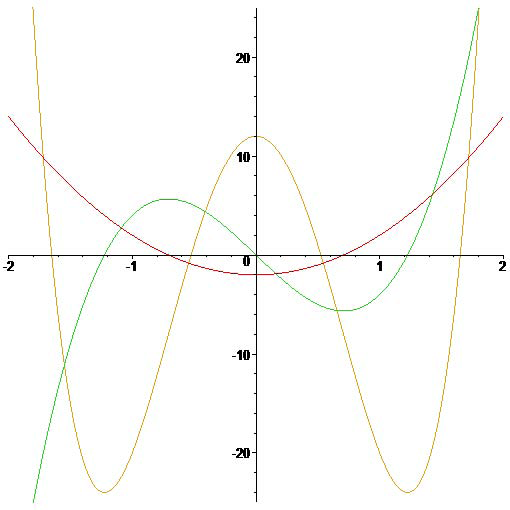
The Hermite polynomials \(H_2(x)\), \(H_3(x)\) and \(H_4(x)\).
Last modified on May 22, 2021


