 Teaching
Differential equations – Laplace transform – Convolution
Theorem: Let \(F(s)=\mathcal{L}\{f(t)\}(s)=\displaystyle\int_0^{\infty}e^{-st}f(t)\,dt\) and \(G(s)=\mathcal{L}\{g(t)\}(s)=\displaystyle\int_0^{\infty}e^{-st}g(t)\,dt\) both exist for \(s>a\geq0\), then we have
\[F(s)G(s)=H(s)=\mathcal{L}\{h(t)\}(s)=\int_0^{\infty}e^{-st}h(t)\,dt,\quad s>a,\]where
\[h(t)=\int_0^tf(t-\tau)g(\tau)\,d\tau=\int_0^tf(\tau)g(t-\tau)\,d\tau.\]This function \(h(t)\) is called the convolution (product) of \(f\) and \(g\). The integrals are called convolution integrals.
Proof: If \(F(s)=\displaystyle\int_0^{\infty}e^{-su}f(u)\,du\) and \(G(s)=\displaystyle\int_0^{\infty}e^{-s\tau}g(\tau)\,d\tau\), then we have:
\[H(s)=F(s)G(s)=\left(\int_0^{\infty}e^{-su}f(u)\,du\right)\left(\int_0^{\infty}e^{-s\tau}g(\tau)\,d\tau\right) =\int_0^{\infty}g(\tau)\left\{\int_0^{\infty}e^{-s(u+\tau)}f(u)\,du\right\}d\tau.\]Now we use the substitution \(u+\tau=t\) or \(u=t-\tau\), then we have:
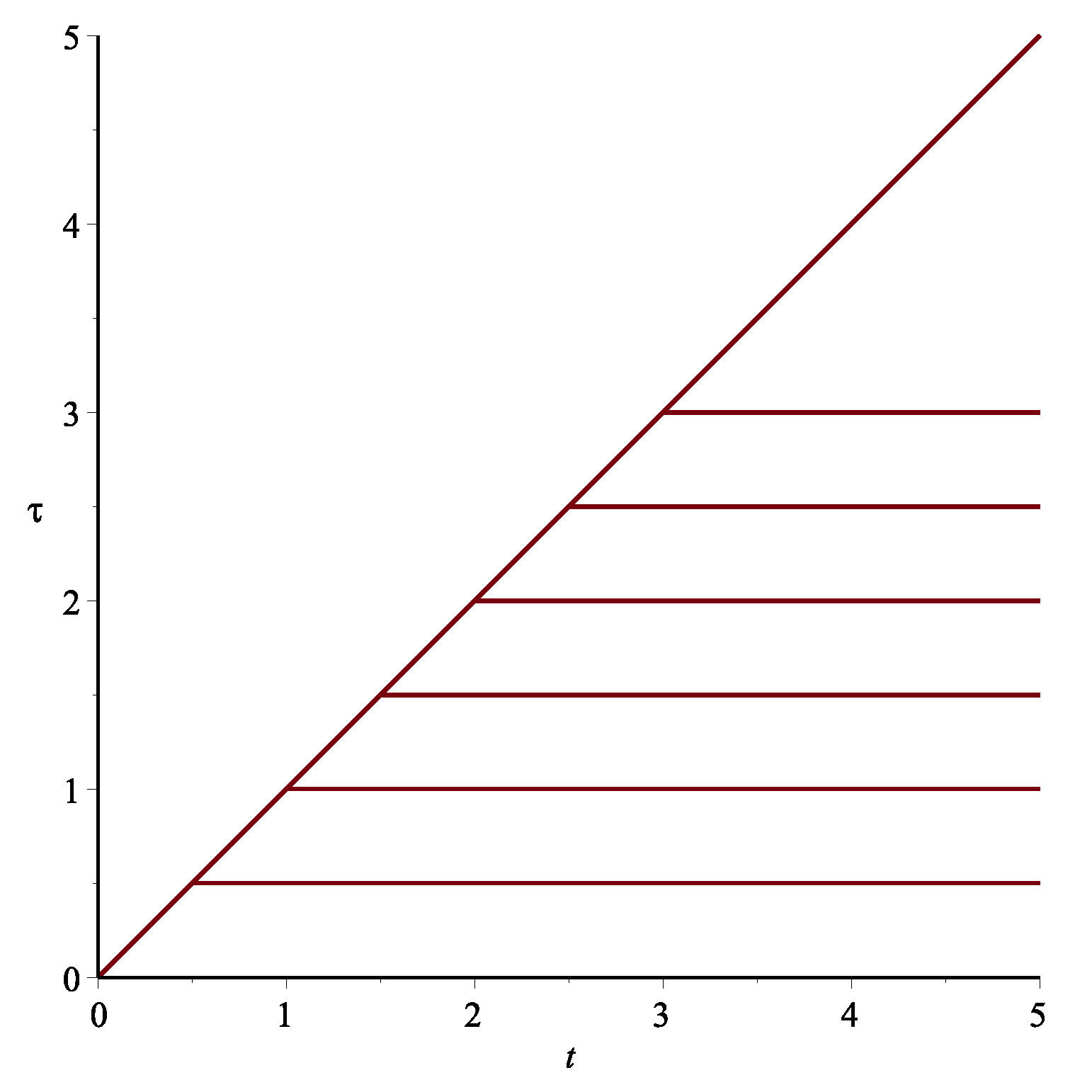
Example: \(H(s)=\displaystyle\frac{s}{(s^2+1)(s^2+4)}=\frac{1}{s^2+1}\cdot\frac{s}{s^2+4}=\frac{s}{s^2+1}\cdot\frac{1}{s^2+4}\). This implies that:
\[h(t)=\int_0^t\sin(t-\tau)\cos(2\tau)\,d\tau\quad\text{and}\quad h(t)=\frac{1}{2}\int_0^t\cos(t-\tau)\sin(2\tau)\,d\tau.\]However, using partial fractions we obtain:
\[H(s)=\frac{s}{(s^2+1)(s^2+4)}=\frac{1}{3}\left(\frac{s}{s^2+1}-\frac{s}{s^2+4}\right)\quad\Longrightarrow\quad h(t)=\frac{1}{3}\left(\cos(t)-\cos(2t)\right).\]The convolution can be used to solve initial-value problems with an arbitrary right-hand side of the differential equation.
Example: Consider the initial-value problem \(y''(t)-5y'(t)+4y(t)=g(t)\), \(y(0)=1\) and \(y'(0)=0\). Let \(Y(s)=\mathcal{L}\{y(t)\}(s)\), then we have:
\[s^2Y(s)-sy(0)-y'(0)-5(sY(s)-y(0))+4Y(s)=G(s)\quad\text{with}\quad G(s)=\mathcal{L}\{g(t)\}(s).\]Using the initial values \(y(0)=1\) and \(y'(0)=0\) we obtain:
\[(s^2-5s+4)Y(s)=s-5+G(s)\quad\Longrightarrow\quad Y(s)=\frac{s-5}{(s-1)(s-4)}+\frac{G(s)}{(s-1)(s-4)}.\]Using partial fractions we find that
\[Y(s)=\frac{4}{3}\frac{1}{s-1}-\frac{1}{3}\frac{1}{s-4}-G(s)\left(\frac{1}{s-1}-\frac{1}{s-4}\right).\]This implies that
\[y(t)=\frac{4}{3}e^t-\frac{1}{3}e^{4t}-\frac{1}{3}\int_0^tg(\tau)\left\{e^{t-\tau}-e^{4(t-\tau)}\right\}dt\quad\text{or}\quad h(t)=\frac{4}{3}e^t-\frac{1}{3}e^{4t}-\frac{1}{3}\int_0^tg(t-\tau)\left\{e^{\tau}-e^{4\tau}\right\}d\tau.\]The convolution can also be used to solve so-called Volterra integral equations of the form \(y(t)+\displaystyle\int_0^tK(s,t)y(s)\,ds=g(t)\) if the kernel \(K(s,t)\) is of convolution type: \(K(s,t)=k(t-s)\).
Examples:
1) Consider \(y(t)+\displaystyle\int_0^te^{t-\tau}y(\tau)\,d\tau=\sin(t)\). Let \(Y(s)=\mathcal{L}\{y(t)\}(s)\), then we obtain:
\[Y(s)+\frac{1}{s-1}\cdot Y(s)=\frac{1}{s^2+1}\quad\Longrightarrow\quad\left(1+\frac{1}{s-1}\right)Y(s)=\frac{1}{s^2+1}.\]Hence:
\[\frac{s}{s-1}Y(s)=\frac{1}{s^2+1}\quad\Longrightarrow\quad Y(s)=\frac{s-1}{s(s^2+1)}=\frac{A}{s}+\frac{Bs+C}{s^2+1}.\]This implies that \(s-1=A(s^2+1)+Bs^2+Cs=(A+B)s^2+Cs+A\) and therefore \(A=-1\), \(B=1\) and \(C=1\). Hence we have
\[Y(s)=-\frac{1}{s}+\frac{s}{s^2+1}+\frac{1}{[s^2+1}\quad\Longrightarrow\quad y(t)=-1+\cos(t)+\sin(t).\]2) Consider \(y(t)=\sin(t)+\cos(t)+\displaystyle\int_0^ty(t-\tau)\sin(\tau)\,d\tau\). Let \(Y(s)=\mathcal{L}\{y(t)\}(s)\), then we obtain:
\[Y(s)=\frac{1}{s^2+1}+\frac{s}{s^2+1}+Y(s)\cdot\frac{1}{s^2+1}\quad\Longrightarrow\quad(s^2+1)Y(s)=1+s+Y(s).\]Then we have:
\[s^2Y(s)=1+s\quad\Longrightarrow\quad Y(s)=\frac{1}{s^2}+\frac{1}{s}\quad\Longrightarrow\quad y(t)=t+1.\]Equations involving both derivatives and integrals of an unknown function are called integro-differential equations, which can also be solved if the integral is of convolution type.
Example: Consider \(y'(t)=1+e^{-t}+\displaystyle\int_0^ty(\tau)\cos(t-\tau)\,d\tau\) with \(y(0)=1\). Let \(Y(s)=\mathcal{L}\{y(t)\}(s)\), then we obtain:
\[sY(s)-y(0)=\frac{1}{s}+\frac{1}{s+1}+Y(s)\cdot\frac{s}{s^2+1}\quad\Longrightarrow\quad\left(s-\frac{s}{s^2+1}\right)Y(s)=1+\frac{1}{s}+\frac{1}{s+1}.\]This leads to
\[\frac{s^3}{s^2+1}Y(s)=\frac{s^2+3s+1}{s(s+1)}\quad\Longrightarrow\quad Y(s)=\frac{(s^2+1)(s^2+3s+1)}{s^4(s+1)} =\frac{s^4+3s^3+2s^2+3s+1}{s^4(s+1)}=\frac{As^3+Bs^2+Cs+D}{s^4}+\frac{E}{s+1}.\]This implies that
\begin{align*} s^4+3s^3+2s^2+3s+1&=As^3(s+1)+Bs^2(s+1)+Cs(s+1)+D(s+1)+Es^4\\[2.5mm] &=(A+E)s^4+(A+B)s^3+(B+C)s^2+(C+D)s+D. \end{align*}Hence we have: \(A=3\), \(B=0\), \(C=2\), \(D=1\) and \(E=-2\). Then finally we obtain:
\[Y(s)=\frac{3}{s}+\frac{2}{s^3}+\frac{1}{s^4}-\frac{2}{s+1}\quad\Longrightarrow\quad y(t)=3+t^2+\frac{1}{6}t^3-2e^{-t}.\]Last modified on April 25, 2021


